
The Story: The Bottleneck in the Heart of Production
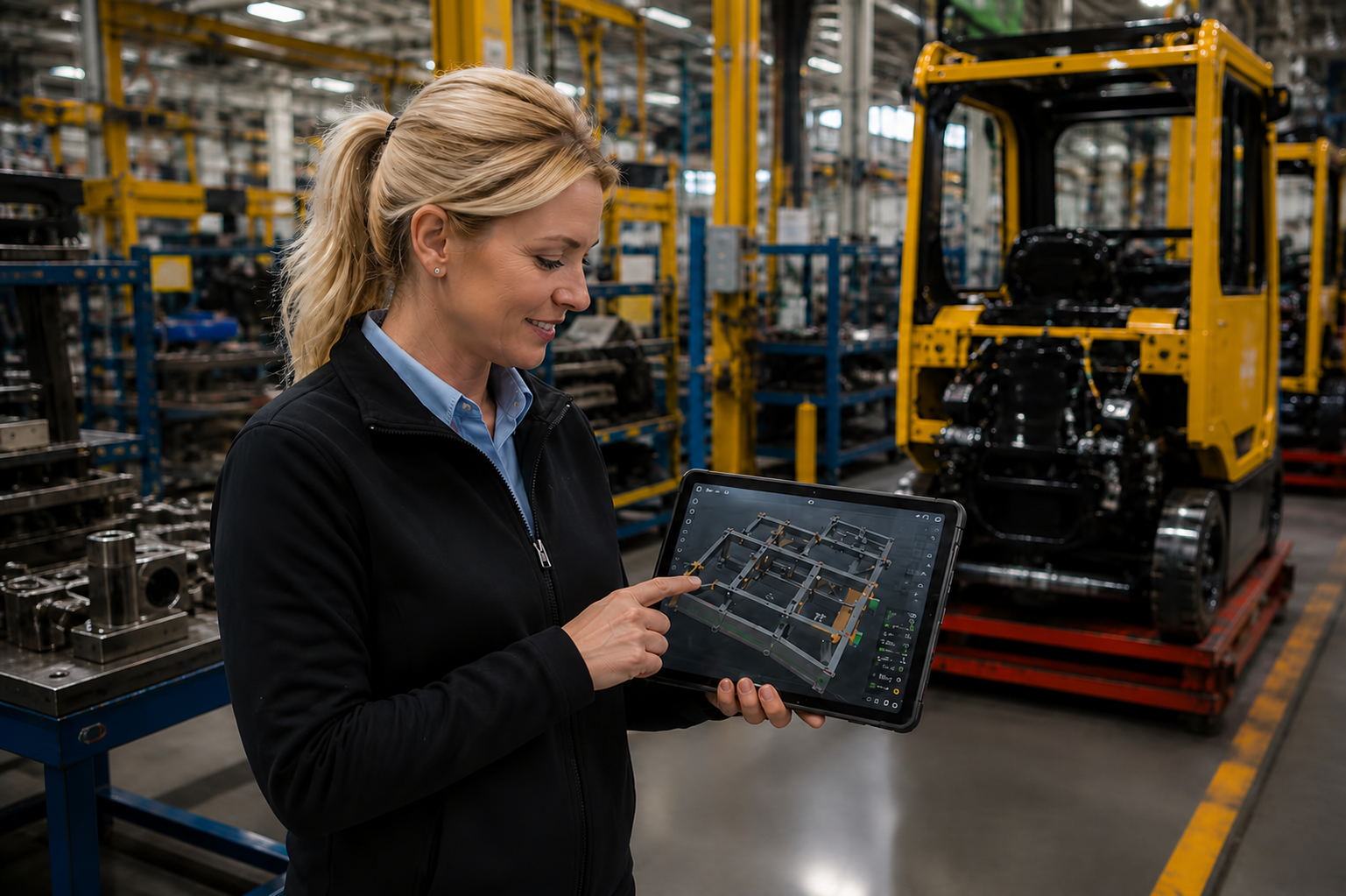
In the sprawling, high-decibelenvironment of the manufacturer's US and European production facilities, the air hums with the energy of creation. Amidst the symphony of whirring machinery and the bright flashes of welding arcs, massive forklift chassis take shape, destined for warehouses and distribution centers across the globe.For the manufacturer, a global leader in material handling equipment the structural integrity of these machines is not just a feature; it is the very bedrock of their brand promise for robust, reliable, and long-lasting equipment. The foundation of each forklift is a complex, heavy-duty welded frame, an intricate skeleton of high-strength steel. For years, ensuring the geometric perfection of this foundation was a monumental task, a major bottleneck that dictated the pace of the entire production line.
Inside a designated quality assurance bay, away from the main assembly frenzy, inspectors engaged in a painstaking, multi-hour ritual of precision and patience. Armed with a combination of handheld calipers, gauges, and massive, custom-built physical jigs, they meticulously measured dozens of critical points on each and every frame. These jigs, themselves marvels of engineering, were monolithic steel structures designed to cradle the weldment and provide fixed reference points. The process was physically demanding, requiring inspectors to maneuver around the hulking frames, and mentally exhausting, as the pressure to maintain focus over a four-hour inspection was immense. A single missed measurement, a moment of lapsed concentration, could have severe downstream consequences, leading to misaligned engine mounts, hydraulic system failures, or, in the worst-case scenario, a costly and brand-damaging product recall.
The human cost of this analog method was a silent drain on the company’s resources. The inspection team, a group of highly skilled and dedicated professionals, faced constant pressure to work faster without sacrificing accuracy—an almost impossible demand. The repetitive nature of the work increased the risk of ergonomic injuries, and the intense focus required led to high levels of job-related stress. Furthermore, the reliance on physical jigs posed significant logistical and financial challenges. Each new frame design, or even a minor modification to an existing one, necessitated the design, fabrication, and commissioning of a new jig—a process that could take months and cost tens of thousands of dollars. These jigs consumed valuable floor space, required regular maintenance and calibration, and represented a massive capital investment sitting idle for much of the time.
The breaking point arrived during the launch of a next-generation forklift, a solidify the manufacturer's market leadership. The design was more complex than anything they had produced before, and the fabrication of the new inspection jigs fell critically behind schedule. With the production line ready to roll and millions of dollars in pre-orders on the line, the QA bottleneck threatened to trigger a costly, cascading delay across the entire launch. The executive team realized they were at a crossroads. The old way was no longer sustainable.The manufacturer needed a digital, agile to break free from the constraints of its analog paradigm and usher in a new era of quality assurance.
How It Works: Superimposing Digital Certainty onto Physical Reality
The manufacturer's solution was a transformative leap into the future of manufacturing: a tablet-based Augmented Reality (AR) inspection system. This was not a tentative pilot program but a full-scale operational overhaul that redefined their quality control process from the ground up. Inspectors now wield ruggedized industrial tablets—a mix of iPads and Android devices chosen for their processing power and durability—to perform inspections with a level of speed and certainty that was previously the stuff of science fiction. The system was designed for seamless integration, creating a closed-loop digital thread that connects the company’s Product Lifecycle Management (PLM) and Manufacturing Execution System (MES) directly to the factory floor.
The new workflow is a masterclass in practical, high-impact innovation, turning a complex task into an intuitive, visually-guided process:
Load the Digital Blueprint: The process begins with a simple action. The inspector scans a barcode affixed to the weldment or selects the corresponding work order on their tablet. Instantly, the correct 3D CAD model is pulled from a secure, cloud-based server and loaded onto the device. This direct link to the central design repository eliminates any risk of using an outdated revision, a common source of error in paper-based systems. The inspector sees a perfect, to-spec digital replica of the frame, ready to be compared against its physical counterpart.
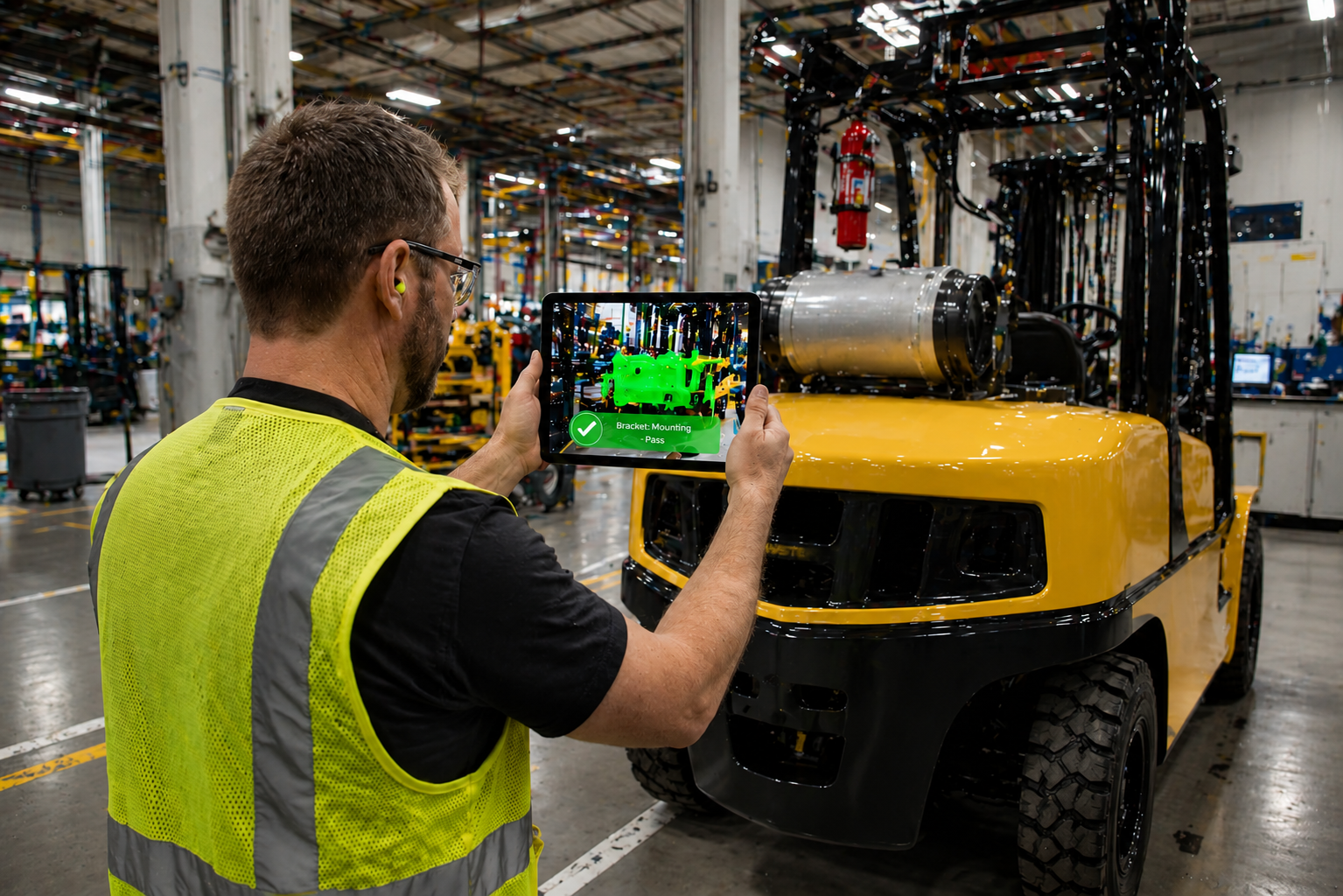
Anchor Reality: This is where the magic happens. The inspector points the tablet’s camera at the physical frame. The AR software’s sophisticated computer vision algorithms get to work, analyzing the live video feed to identify key geometric features—specific holes, corners, and edges. Within seconds, it recognizes the part and precisely anchors the 3D CAD model over the physical object, creating a stable, one-to-one digital twin overlay that remains perfectly locked in place, even as the inspector moves around. This is not a floating, jittery image; it is a decisive, millimeter-accurate superimposition of digital truth onto physical reality.
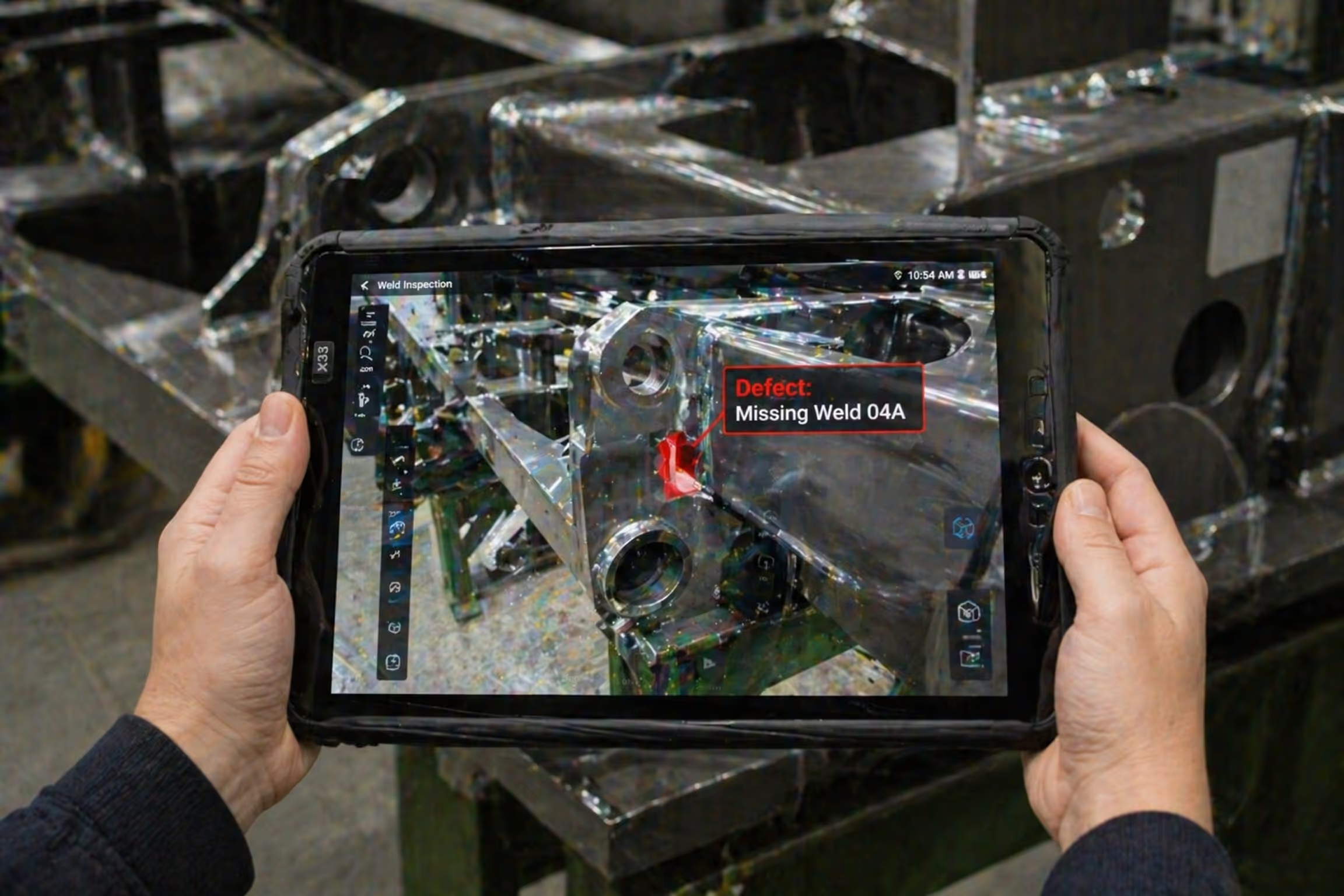
AR Inspection Walk-Around: With the digital twin firmly superimposed, the inspection becomes a guided, interactive exploration. The inspector walks freely around the large frame, viewing it from any angle, and the AR overlay remains perfectly aligned. The software guides them through a pre-defined sequence of checkpoints, highlighting each one in a clear, color-coded interface. Green indicates a point is within tolerance; yellow signals a borderline measurement; red flags a clear deviation. The inspector can virtually "peel back" the digital model to see the physical part underneath or tap on any highlighted point in the AR overlay to instantly access detailed specifications, tolerances, and assembly instructions without ever looking away from the part.
Instant Visual Verification and Documentation: The system’s true power lies in its ability to make deviations instantly and unambiguously visible. If a bracket is misaligned, a hole is drilled in the wrong place, or a weld is missing, the discrepancy between the green digital model and the physical part beneath it is immediately obvious on the tablet’s large, high-resolution screen. When a defect is found, the inspector can, with a single tap, capture a photo or a short video of the issue. The system automatically annotates this visual evidence with the AR overlay, circling the problem area and attaching all relevant metadata—part number, inspector ID, timestamp, and specific tolerance data. This rich, indisputable digital report is then automatically routed to the welding department’s dashboard for immediate corrective action, eliminating ambiguous paper forms and verbal miscommunications.
This AR-powered workflow transforms a multi-hour, high-stress, and error-prone task into a swift, intuitive, and highly accurate verification routine. The inspectors, some of whom had been using the old manual methods for decades, were initially skeptical. However, the system’s intuitive design and the immediate, tangible benefits won them over. After a short, hands-on training program, they became proficient and enthusiastic users, evolving from manual laborers into high-tech quality auditors who now felt empowered by, rather than burdened by, their work.
Departmental Impact: A Ripple Effect of Quality
tablet-based AR at the manufacturer was not an isolated improvement for the QA department; it was a catalyst that sent a powerful, positive ripple effect across the entire production ecosystem, optimizing workflows and fostering a culture of data-driven quality.
Quality Assurance:
This department experienced the most immediate and dramatic transformation. Inspection times were decimated, falling by over 90%, and accuracy skyrocketed. The digital, non-subjective nature of the AR overlay eliminated the guesswork and variability inherent in manual measurement, leading to a near-perfect first-pass yield. The role of the inspector was elevated from a manual task-performer to a high-tech quality auditor and data analyst. Morale and job satisfaction soared as inspectors were empowered with a tool that made their work more efficient, more accurate, and less physically taxing. Furthermore, the system automatically generated a rich, searchable database of every inspection, complete with annotated images. This allowed QA managers to perform trend analysis, identifying recurring issues and proactively addressing root causes before they became systemic problems.
Welding & Fabrication:
The feedback loop to the welding department became a superhighway. Previously, a welder might produce a dozen non-conforming parts before a defect was caught hours later in QA. Now, the moment a deviation was detected, an alert with a crystal-clear, annotated image of the problem was sent directly to the welding supervisor’s terminal. Welders could see exactly what was wrong—a weld bead that was too thin, a bracket off by a few millimeters—and correct their technique or jig setup in near real-time. This immediate, actionable intelligence prevented the propagation of errors, dramatically reducing the need for costly rework and slashing the scrap rate.
Main Assembly Line:
The assembly line, the heartbeat of the factory, began to receive a steady, predictable, and reliable flow of perfectly verified frames. The persistent, frustrating problems of downstream fitting issues—engine mounts that wouldn’t align, hydraulic lines that wouldn’t connect, cabins that wouldn’t seat properly—vanished almost overnight. The domino effect of this newfound consistency was profound. Line stoppages, which had been a frequent and costly headache, were virtually eliminated. The entire assembly process became smoother, faster, and more predictable, boosting overall plant throughput.
Engineering & Design (R&D):
The AR inspection system created an invaluable bridge between the factory floor and the design office. For the first time, engineers had access to a treasure trove of real-world, as-built data. By analyzing the aggregated inspection data, they could identify patterns of deviation and gain unprecedented insights into how their designs behaved in a real production environment. They could see which tolerances were consistently difficult to achieve, suggesting a design for manufacturability (DFM) improvement. Conversely, they could identify areas where tolerances were unnecessarily tight, allowing them to relax specifications without impacting quality, thereby reducing manufacturing costs. This data-rich feedback loop fostered a more collaborative and effective relationship between design and production.
IT & Operations:
The IT department was a crucial partner in the successful deployment and scaling of the AR solution. Their role extended far beyond simply managing the fleet of tablets. They were responsible for ensuring robust, high-bandwidth Wi-Fi connectivity across the entire factory floor, a non-trivial task in a large, steel-framed industrial environment. They also managed the security of the CAD data, implementing protocols to ensure that this valuable intellectual property was protected at all times. Their expertise in enterprise architecture was vital for seamlessly with the manufacturer's existing MES and PLM systems creating the unified digital thread that made the entire process so powerful and efficient.
Quantified Business Impact: The Numbers That Matter
The strategic decision to replace physical jigs with a tablet-based AR inspection system was not a leap of faith; it was a calculated business move that delivered a swift, substantial, and multi-layered return on investment (ROI).
90-95% Reduction in Inspection Time: This was the headline metric and the most immediate win. The laborious, manual inspection process, which previously consumed between 2 and 4 hours for each complex frame, was reduced to a mere 15-20 minutes. This staggering 90-95% reduction did more than just save labor hours; it completely eliminated a critical production bottleneck. The QA department could now keep pace with, and even get ahead of, the fabrication department, ensuring a smooth and continuous flow of parts to the assembly line.
100% Elimination of Downstream Assembly Stoppages Due to Frame Errors: The financial impact of an assembly line stoppage can be immense, running into thousands of dollars per minute. By ensuring that only 100% correct frames reached the main assembly line, the AR system eradicated a major and unpredictable source of these costly delays. The result was a more predictable production schedule, higher overall equipment effectiveness (OEE), and annual savings estimated in the hundreds of thousands of dollars from avoided downtime alone.
Complete Eradication of Physical Jig Management Costs: The company was able to completely divest from the costly and inefficient ecosystem of physical inspection jigs. This resulted in the elimination of significant recurring expenses, including the tens of thousands of dollars spent on designing and fabricating new jigs for each new product variant, the costs of storing and maintaining the massive jig inventory, and the labor associated with their calibration and transport. The ROI on the AR software and hardware investment was achieved in less than six months, driven largely by these direct cost savings.
Drastic Reduction in Rework and Scrap: The near real-time feedback loop to the welding department had a direct impact on the bottom line. By catching errors at the source, the system prevented the creation of serial defects, leading to a significant reduction in the amount of high-value material being scrapped and a dramatic decrease in the man-hours spent on rework. This not only saved money but also improved overall production capacity by freeing up skilled welders to focus on value-added production rather than fixing mistakes.

Conclusion: The Future of Quality is Visual, Digital, and Accessible
The manufacturer's case study is more than just a story of successful technology adoption; it is a powerful demonstration of a fundamental shift in the philosophy of manufacturing quality control. It proves that the most advanced technologies, like Augmented Reality, can be deployed in a remarkably accessible and intuitive way to deliver an immediate, profound, and multifaceted ROI. By courageously embracing a digital-first approach to a decades-old problem,the manufacturer has not only shattered a critical production bottleneck but has also fortified its entire production pipeline, creating a more agile, data-driven, and competitive operation.
The most crucial lesson from this transformation lies in its accessibility. The manufacturer wisely bypassede power of AR into the hands of their existing workforce with minimal friction. This is not a technology confined to the R&D labs of the distant future; it is a practical, proven, and robust solution that is delivering transformative value on factory floors todayThe inspectors at the manufacturer did not need; they just needed a tool that made their jobs easier, and the intuitive visual interface of the AR system did exactly that.
The story of the manufacturer serves a for any industrial company feeling the constraints of outdated, analog processes. It highlights that the true path to Industry 4.0 is not about technology for technology’s sake, but about the strategic application of the right technology to solve real-world business problems. The lesson is unambiguous: in today’s rapidly evolving industrial landscape, the biggest risk is not in investing in a new technology like tablet-based AR, but in clinging to the false security of outdated methods while the competition innovates and pulls ahead. The future of quality is visual, it is digital, and as the manufacturer has proven, it is here now.
Frequently Asked Questions
Q1We manufacture heavy-duty agricultural equipment, not forklifts. Can a similar AR solution work for our complex weldments?
A: Absolutely. The principles of AR-guided inspection are transferable to any industry dealing with large, complex welded structures, including agricultural machinery, construction equipment, aerospace, and shipbuilding. The system uses your specific CAD models, so it can be adapted to any geometry or inspection requirement, helping you eliminate physical jigs and reduce inspection bottlenecks just like Hyster-Yale.
Q2How long does it take to deploy a tablet-based AR inspection system and what does it cost?
?A: A typical pilot program can be deployed in as little as 6-8 weeks, which includes software setup, integration with your CAD systems, and on-site team training. The cost is subscription-based and depends on the number of users and the complexity of the integration. It is significantly more cost-effective than the continuous cycle of designing, fabricating, and storing physical jigs, providing a rapid return on investment.
Q3 What is the real-world ROI, and how soon can we expect to see results?
?A: The ROI is multi-faceted. Customers typically see a 90-95% reduction in inspection time almost immediately. This directly translates to increased throughput and faster time-to-market. The complete elimination of costs associated with physical jigs (design, fabrication, storage, maintenance) provides significant savings. Most importantly, by catching errors at the source, you prevent costly downstream rework and assembly line stoppages, with results visible within the first few months of deployment.
Q4We\\\'re convinced. How do we get started and what are the next steps?
A: The first step is a brief consultation to understand your specific challenges and inspection workflow. From there, we can schedule a personalized demo using your own CAD models to give you a firsthand look at the solution\\\'s capabilities. To begin the conversation, please contact Vandana Bansal at vandana@metaverse911.co.uk for opportunities in India, or Vandana Bansal at vandana@metaverse911.co.uk for Global inquiries.
For India: Rrahul Sethi at rrahul@metaverse911.in
For Global inquiries: Vandana Bansal at vandana@metaverse911.co.uk