
The Story
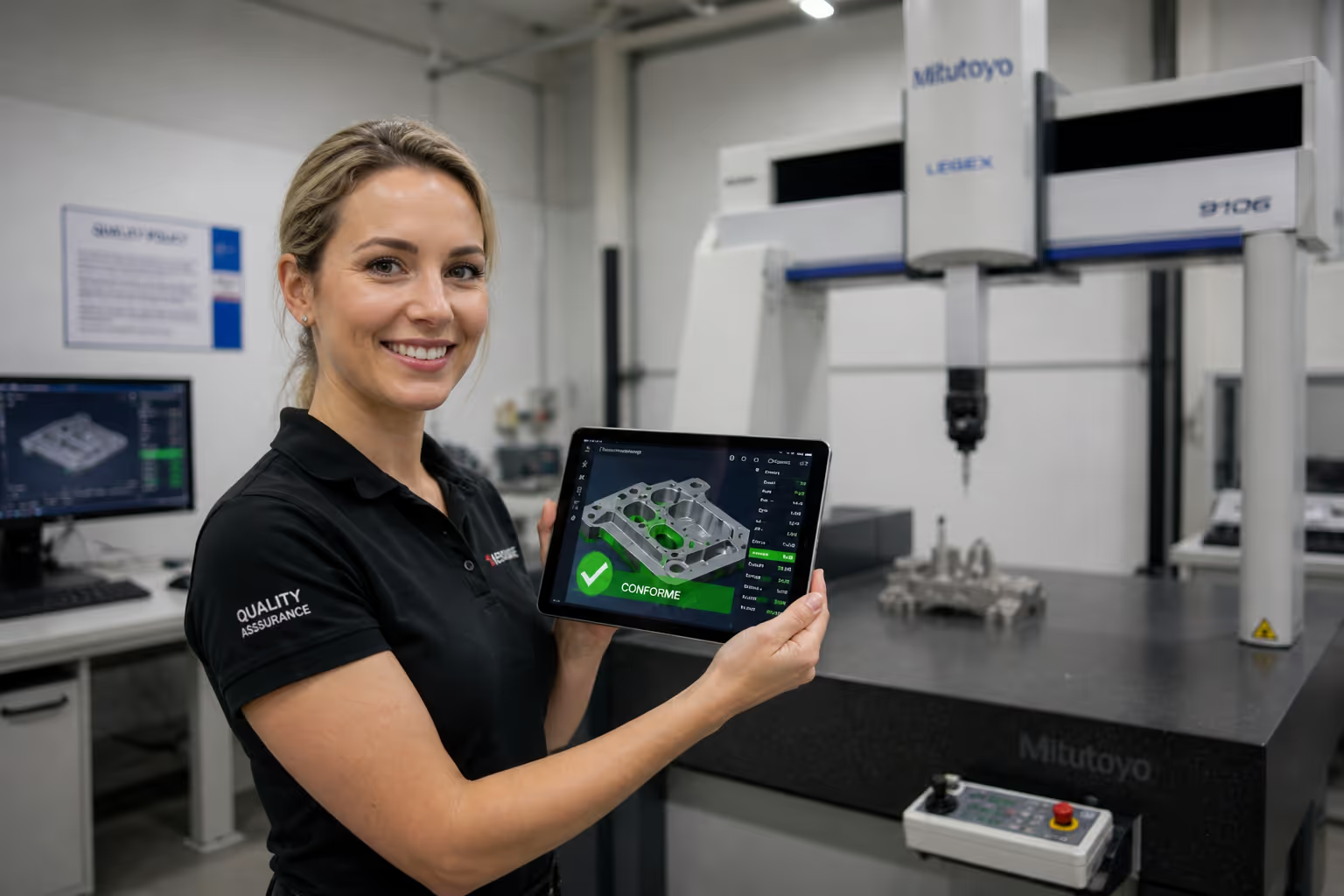
In the world of semiconductor manufacturing, precision is the absolute foundation of the industry. For a leading vacuum technology manufacturer, a name synonymous with critical vacuum technology, this reality is a daily operational mandate. The vacuum chambers they produce are the silent, unseen heart of semiconductor fabs, environments where a single microscopic deviation can derail a multi-million-dollar production run. The integrity of every port, the angle of every flange, and the placement of every internal structure must be perfect..
This relentless demand for perfection created a significant challenge at the very beginning of their value chain: incoming quality control. When the manufacturer received complex, custom-machined components from their network of suppliers, each part had to undergo a rigorous inspection to verify its adherence to nanometer-level specifications. The traditional tool for this job was the Coordinate Measuring Machine (CMM), a marvel of metrology capable of incredible accuracy. However, the CMM was also a significant bottleneck. The trigger for change came with a new generation of vacuum chambers, whose geometric complexity and tighter tolerances pushed the CMM bottleneck from a manageable inconvenience to a full-blown crisis.
Setting up a complex vacuum chamber on a CMM was a painstaking, time-consuming process. It required specialized technicians and tied up a machine worth hundreds of thousands of euros for hours at a time. As a result, a massive queue of high-value components would form in the receiving department, waiting for their turn on the CMM. This logjam had a direct, cascading impact on production schedules. Verified parts couldn't flow to the assembly line, delaying the start of production and creating friction with both suppliers and internal stakeholders. The very machine meant to ensure quality had become a barrier to operational velocity. The receiving department, intended to be a gateway, had become a gatekeeper.
.avif)
How It Works
The leadership at the company knew that to break the CMM bottleneck they needed a solution that was not only precise but also fast and flexible. They found their answer not in a more expensive CMM or a larger inspection team, but in the accessible power of tablet-based Augmented Reality.
The new process is a study in elegant simplicity and profound efficiency. When a complex vacuum chamber arrives from a supplier, the quality inspector no longer escorts it to the CMM queue. Instead, they place it on a standard workbench in the receiving area. The inspector then takes a ruggedized, industrial-grade tablet and launches a specialized AR application. The application allows the inspector to pull up the correct CAD model for the component with a simple scan of the part's barcode, ensuring that the inspector is always working with the latest, most accurate version of the design
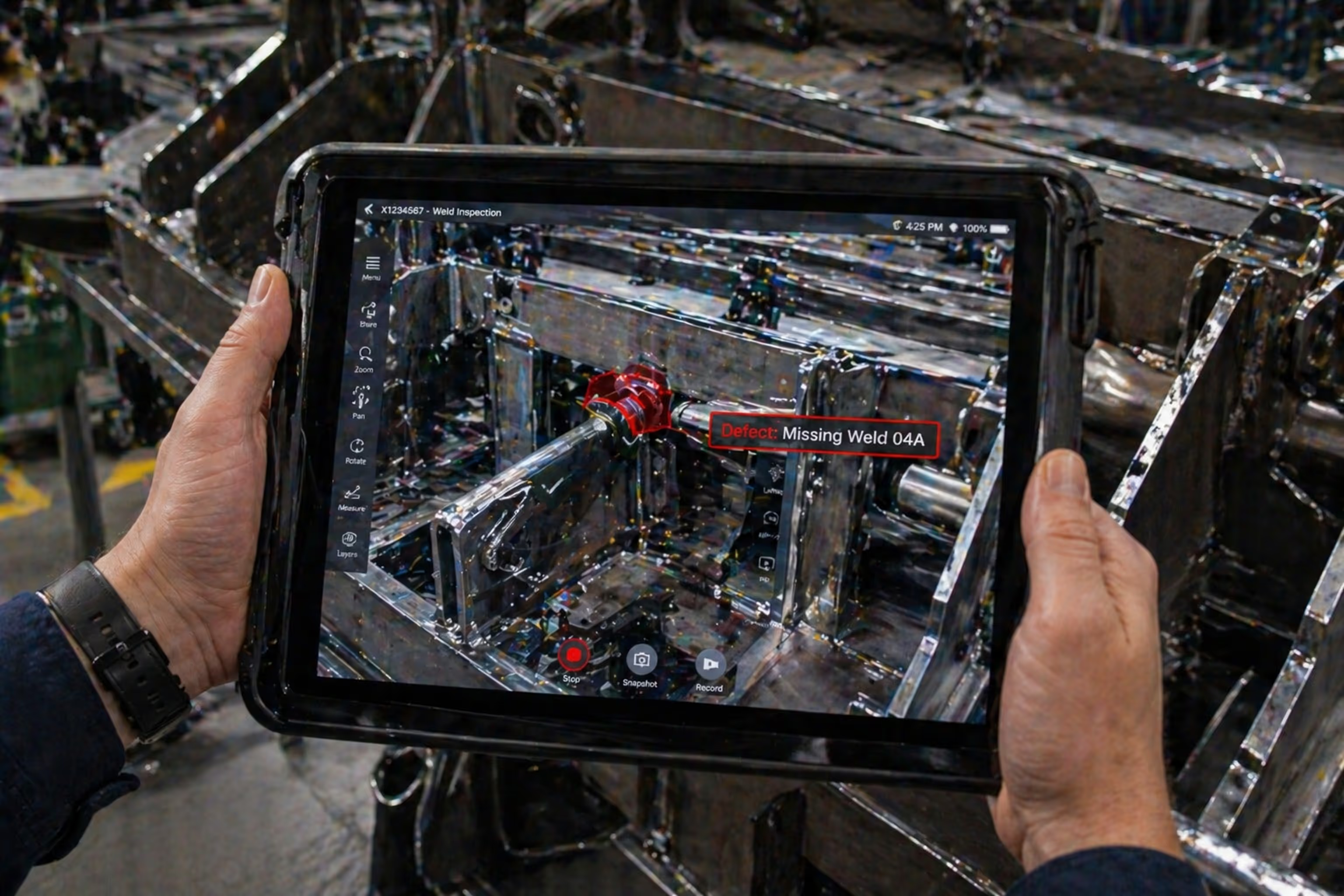
As they point the tablet’s camera at the component, the magic happens. The AR software, pre-loaded with the component’s master 3D CAD model, instantly recognizes the physical part and superimposes the digital blueprint over the live camera feed. On the screen, the inspector sees a perfect fusion of the real and the digital. A translucent, color-coded wireframe of the CAD model snaps precisely onto the physical vacuum chamber. Every port, flange, and internal structure is now overlaid with its digital twin.
This AR-powered visual inspection allows the inspector to perform a comprehensive triage in seconds, not hours. They can walk around the part, viewing it from any angle, and instantly see if there are any gross deviations:
Presence and Location: Is a port missing or in the wrong place?
Angle and Orientation: Is a flange welded at the correct angle?
Internal Structures: Are the internal baffles correctly positioned?
Any discrepancy between the digital overlay and the physical part becomes immediately obvious. A green highlight might indicate a perfect match, while a red or yellow warning could flag a potential deviation. The inspector can tap on specific features on the tablet to get detailed tolerance information pulled directly from the CAD data. This process doesn’t replace the CMM entirely; it optimizes its use. The AR inspection is a rapid triage tool. It allows the inspector to quickly identify and reject parts with obvious, non-conforming errors, preventing them from ever consuming valuable CMM time. Only the parts that pass this initial visual check, or those that have ambiguous results, are then escalated for a full, time-consuming CMM measurement. A comprehensive training program was developed to ensure that all inspectors were comfortable and proficient with the new technology, and the inspectors quickly embraced the new tool. The bottleneck was not just solved; it was intelligently managed.
Departmental Impact
The implementation of tablet ARat the vacuum technology manufacturer, fundamentally reshaping workflows and improving inter-departmental dynamics.
Incoming Quality Control (IQC):
The IQC team was transformed from a bottleneck into a high-speed triage unit. Inspectors, now empowered with AR, could make critical quality decisions with unprecedented speed and confidence. The ability to instantly identify and document supplier deviations with visual, indisputable evidence (a screenshot from the tablet) streamlined the rejection process andstrengthened the manufacturer's position in supplier negotiations. The morale of the team improved as they were now equipped with a cutting-edge tool that made their work more efficient and impactful.
Production Planning:
For the production planners, the AR solution was a game-changer. The chronic delays originating from the receiving department vanished. The flow of verified, high-quality components to the production line became predictable and consistent. This stability allowed for more accurate production scheduling, reduced idle time on the assembly floor, and enabled the entire facility to operate at a higher tempo. The elimination of the CMM bottleneck meant that the entire production lifecycle could start sooner, leading tofor the manufacturer's own customers
Engineering:
The engineering department also saw significant benefits. The AR system provided a powerful new tool for design validation. Engineers could now take a new design, load it onto a tablet, and overlay it onto a physical prototype, allowing them to spot potential design flaws or manufacturing issues long before the component went into full production. This ability to "see" the design in the real world led to more robust and manufacturable designs, reducing the number of costly engineering change orders down the line.
Procurement:
The procurement team found their negotiations with suppliers transformed. The clear, visual evidence of non-conformance provided by the AR system left no room for argument. This led to faster and more favorable resolutions to quality disputes, and it also provided a valuable feedback mechanism for suppliers, helping them to improve their own quality control processes. Over time, this led to a stronger, more collaborative relationship with the entire supply chain.
Quantified Business Impact
Drastic Acceleration of Inspection: The receiving inspection process for complex components was dramatically accelerated. An inspection that might have taken 2-4 hours to set up and run on a CMM could now be triaged in under 5 minutes with the AR tablet. This represents a time reduction of over 95% for the initial quality check.
Optimized CMM Utilization: The company’s expensive CMM machines were freed up to focus on what they do best: final verification of critical dimensions and first-article inspections. the company optimized the utilization of this capital-intensive asset, ensuring that its time was not wasted on components with obvious flaws. This extended the CMM’s capacity without requiring new investment, effectively boosting the ROI of their existing equipment.
Streamlined Supplier Dispute Resolution: When a part was rejected, the AR system provided immediate, unambiguous evidence. A screenshot showing the digital overlay clashing with the physical part was far more powerful than a complex CMM report. This visual evidence accelerated supplier dispute resolution, reduced back-and-forth arguments, and helped suppliers improve their own processes faster. This led to a measurable decrease in the average time-to-resolution for quality issues, and a corresponding improvement in supplier performance.
Enhanced Audit Compliance and Sustainability: The AR system also provided a comprehensive digital audit trail for every inspection. This made it much easier to demonstrate compliance with industry regulations and customer requirements. The ability to quickly and accurately document every step of the inspection process was a significant advantage in a highly regulated industry. This also contributed to sustainability goals by reducing the need for paper-based documentation and minimizing waste from rejected parts.
Reduced Production Delays: By ensuring a faster, more predictable flow of quality-approved parts, the AR system directly reduced production delays. This had a direct positive impact on revenue, as finished products could be shipped to customers sooner. The faster time-to-market for their products gave the manufacturer a significant competitive advantage.

Conclusion
The vacuum technology manufacturer case study is a powerful testament to the pragmatic application of Industry 4.0 technology. It proves that the most impactful digital transformations are not always the most futuristic or complex. In an industry obsessed with the promise of head-mounted displays, this manufacturer chose a different path—one that was grounded in the reality of their factory floor. They demonstrated that tablet AR is not a lesser version of "true" AR; it is a mature, enterprise-ready solution that is perfectly suited for tasks requiring high-precision visual verification. By leveraging the familiar form factor of a tablet, they bypassed the ergonomic, safety, and user-adoption hurdles that so often plague wearable AR initiatives. The result was a solution that was not only effective but also rapidly scalable and immediately embraced by the workforce.
For manufacturers in any high-precision industry—from aerospace and defense to medical devices and automotive—the lesson here is clear is clear. You do not need to wait for the next generation of unproven wearables to start your digital inspection journey. The technology to eliminate bottlenecks, empower your quality team, and accelerate your production is already here, running on the devices your team already knows how to use. The question is not whether you should adopt it, but how quickly you can deploy it to gain a competitive edge. Imagine a future where every technician on your factory floor is equipped with the power to see the digital and physical worlds as one, where quality issues are caught and corrected in an instant, and where the flow of production is never again held hostage by a bottleneck in the inspection process. This is the future that tablet AR delivers, and it is a future that is within your reach.
Frequently Asked Questions
Q1Q: Can a similar AR solution work for my industry, like heavy machinery manufacturing, where parts are large and tolerances are still critical?
A: Absolutely. The principles of tablet-based AR for quality control are highly adaptable. For heavy machinery, the core benefit remains the same: overlaying a 3D CAD model onto a physical part for rapid visual inspection. This can be used to verify the placement of major components, check weld seams, and ensure that large-scale assemblies are correctly configured before they move to the next stage, saving significant time and rework costs.
Q2How long does it take to deploy a tablet-based AR inspection system, and what are the typical costs involved?
A: A pilot project can often be deployed in as little as 4-6 weeks. The cost is significantly lower than investing in a new CMM. It typically involves a subscription to the AR software, the cost of ruggedized tablets, and a one-time setup and training fee. The total investment is a fraction of the cost of the problem it solves
Q3 What's the realistic ROI we can expect from implementing a tablet AR solution, and how soon can we see a payback?
A: The ROI is multi-faceted. You can expect a 90%+ reduction in inspection time for initial checks, optimized use of expensive CMMs, and a significant reduction in production delays. Most companies see a full payback on their investment in under 6 months, with the benefits continuing to accrue long after.
Q4 How do we get started with a pilot project? What are the next steps to see this in action on our factory floor?
A: The next step is a simple, no-obligation discovery call to discuss your specific inspection challenges. From there, we can arrange a live demo and scope out a pilot project for one of your key components. To get started, please contact Rrahul Sethi at rrahul@metaverse911.in for India, or Vandana Bansal at vandana@metaverse911.co.uk for Global inquiries.
For India: Rrahul Sethi at rrahul@metaverse911.in
For Global inquiries: Vandana Bansal at vandana@metaverse911.co.uk