

The Story: The Pursuit of Perfection in Leipzig
In the heart of Austria, within the state-of-the-art facilities of a leading injection moulding machinery manufacturer the ethos of precision is not just a goal; it is the very foundation of their global reputation. The manufacturer produces colossal, bespoke machines, bespoke machines, some the size of a small bus, that are marvels of modern engineering. These are not mass-produced items but custom-configured titans of industry, each with an intricate and unique nervous system of hydraulic lines, electrical wiring, and high-precision mechanical components. For their customers, who operate in the most demanding sectors of manufacturing, from automotive to medical technology, these machines must function in perfect, uninterrupted harmony from the moment they are commissioned.
The final quality check, the last line of defense before a machine worth millions of euros is dispatched, was traditionally a monumental undertaking. It was a process steeped in experience and diligence, but also fraught with inherent human limitations. Veteran inspectors, individuals with decades of accumulated knowledge, would stand before a newly assembled machine, armed with binders containing hundreds of pages of dense, 2D paper schematics. Their task was a high-stakes, three-dimensional game of ‘spot the difference,’ where they had to mentally translate complex, flat drawings into the sprawling, multi-layered reality of the machine before them. It was a process that demanded immense concentration and was performed under constant, significant pressure. A single overlooked deviation, a hydraulic line misrouted by a few centimeters, or an electrical connection not torqued to the exact specification, could have catastrophic consequences.
The potential fallout from a post-shipment failure was a constant source of anxiety. If an error was discovered at a customer’s facility, perhaps on the other side of the world, the domino effect would be immediate and severe. It would trigger a cascade of costly emergency flights for specialist technicians, complex on-site rework in a less-than-ideal environment, and, most damagingly, significant production delays for the customer. Each such incident was a blow to the manufacturer's hard-won reputation for unwavering quality and reliability. The pressure for absolute perfection was therefore not just a quality metric; it was a commercial imperative. The margin for error was, for all practical purposes, zero.
The tipping point did not arrive as a single, dramatic event, but as a gradual, dawning realization within the company’s leadership and engineering teams. As the manufacturer's machines grew ever more complex, incorporating sophisticated new technologies and customer-specific customizations, the traditional paper-based inspection process was stretched to its breaking point. It was becoming an increasingly significant bottleneck and, more worryingly, a source of unacceptable risk. The sheer volume and complexity of the information that inspectors had to process and verify was exceeding the practical limits of human cognition.The manufacturer recognised that to uphold its commitment to perfection and to future-proof its operations, it needed a more robust, reliable, and scalable method to ensure that every single machine leaving their factory was, in fact, flawless.
The stage was set for a technological leap that would not only solve this critical challenge but would also go on to redefine the standards of quality assurance across the entire capital equipment manufacturing industry.
How It Works
To safeguard its legacy of absolute perfection, The manufacturer made a strategic and forward-thinking decision to embrace a tablet-based Augmented Reality (AR) system for the final, critical quality checks of its machine assemblies. This was not a tentative experiment but a decisive move to fundamentally re-engineer their quality assurance process, aiming to make it more efficient, unerringly accurate, and transparently reliable. This industrial augmented reality solution was designed to transform a laborious, high-pressure manual task into a streamlined, digitally-guided workflow, thereby setting a new and formidable industry benchmark for quality control.
The elegance of the system lies in its ability to seamlessly overlay critical digital information directly onto the physical world, creating an enriched, interactive reality for the quality inspector. The process begins when an inspector, equipped with a rugged, industrial-grade tablet, approaches a newly assembled machine. By simply scanning a unique QR code affixed to the machine’s chassis, the AR application instantly identifies the specific machine and retrieves its corresponding “digital twin" from the manufacturer's secure central server This digital twin is a highly detailed, 3D CAD model that is a perfect, one-to-one virtual replica of the physical machine, including every wire, hose, and component as specified in the final design.
With the digital twin loaded, the tablet’s screen becomes a magic window into this enhanced reality. The application uses sophisticated algorithms to superimpose the 3D CAD model onto the live camera feed of the physical machine. As the inspector walks around the colossal piece of equipment, the tablet displays glowing, color-coded digital lines and indicators that are precisely overlaid onto the physical hoses, cables, and wires. These digital overlays illustrate the correct, intended routing paths with unambiguous clarity. This provides an immediate, real-time visual reference that allows the inspector to spot any deviation from the design specification in an instant. A hydraulic hose that has been routed on the wrong side of a support bracket, for example, becomes immediately obvious, as the physical hose will not align with the glowing digital path on the tablet’s screen.
The system is not just a visual guide; it is an interactive inspection tool. By tapping on any component or connection point on the tablet’s screen, the inspector can instantly access a wealth of additional information. This could include the correct part number, the required torque for a specific bolt, the pressure rating for a hydraulic fitting, or a step-by-step checklist for a particular sub-assembly. This ability to access context-sensitive data on demand eliminates the need for the inspector to leave the machine to consult paper documents or a separate computer terminal, dramatically improving efficiency and reducing the potential for error.
Recognizing that even the most advanced technology is only as effective as the people who use it, The manufacturer invested in a comprehensive training programme that, combined with the system’s highly intuitive, user-friendly tablet interface, ensured rapid and enthusiastic adoption by the inspection teams. The entire system operates on a secure, closed-loop network,ensuring that the manufacturer's valuable and proprietary design data is protected at all times. This digital transformation has not only slashed the inspection timeline but has also introduced an unprecedented level of precision, accountability, and data-driven insight into the manufacturer's world-class manufacturing operations.
Departmental Impact
The strategic adoption of tablet-based AR at the manufacturer was not a siloed initiative but a transformative force that created a powerful ripple effect of enhanced efficiency, quality, and collaboration across a wide range of departments.
Production & Assembly:
For the teams on the shop floor, the AR system provided a clear, unambiguous, and interactive guide to the complex assembly process. This led to a significant reduction in assembly errors and a corresponding decrease in the amount of rework required. The ability to visualize the final, correct state of the assembly in 3D, rather than interpreting 2D drawings, empowered the assembly technicians to work with greater speed and confidence. This, in turn, had a positive impact on production schedules and overall throughput.
Final Quality Assurance:
The final quality assurance team, the primary users of the system, experienced the most dramatic and immediate impact. The once time-consuming and mentally taxing process of manual inspection was transformed into a highly efficient, digitally-assisted workflow. Inspectors, now armed with a tool that augmented their own expertise, could verify the complex, custom routing of hundreds of hydraulic lines and electrical wires in a fraction of the time it had previously taken. This not only boosted productivity but also significantly increased job satisfaction by reducing the stress associated with the high-stakes nature of their work.
Engineering & Design:
The data generated by the AR inspection system created a valuable feedback loop for the engineering and design departments. By capturing and analyzing data on common assembly errors or areas of ambiguity, the design teams were able to identify opportunities to improve the design of the machines for easier and more intuitive assembly. This data-driven approach to design for manufacturability led to a continuous cycle of improvement, resulting in more robust and efficient machine designs over time.
IT Department:
The IT department played a crucial role in the successful implementation and ongoing management of the AR system. They were responsible for ensuring the security and integrity of the digital twin data, as well as the reliability and performance of the on-site network. The successful rollout of the system was a testament to the close collaboration between the IT and operations teams, and it served as a showcase for the IT department’s ability to deliver cutting-edge technology solutions that create real business value.
Customer Service & Commissioning:
The benefits of the AR system extended far beyond the four walls of the factory, having a significant positive impact on the customer service and commissioning teams. Previously, the discovery of an assembly error during the on-site installation and commissioning of a machine at a customer’s facility was a major headache, triggering a cascade of costly and time-consuming remedial activities. By catching virtually all assembly errors before the machine leaves the factory, the AR system has drastically reduced the number of issues discovered during commissioning. This has resulted in significant cost savings, a smoother and faster installation process, and a greatly enhanced customer experience, further strengthening the manufacturer's reputation as a reliable and high-quality partner.
Quantified Business Impact
The implementation of tablet-based Augmented Reality at implementation at the manufacturer was not just a showcase; it delivered a significant, measurable, and multi-faceted return on investment. The value of this strategic move is reflected in hard numbers that unequivocally underscore its profound impact on the business.
A key and immediately apparent outcome has been a dramatic reduction in the time required for final inspection. The AR system has, on average, slashed inspection times by an astonishing 75%. This has not only increased the throughput of the final assembly and quality assurance stages but has also done so without compromising the meticulous rigor of the inspection process. The significant number of man-hours saved is now reallocated to other value-added activities, such as preventative maintenance and continuous improvement initiatives, further boosting the overall operational efficiency of the facility.
Furthermore, and perhaps more significantly from a financial perspective, the company has experienced a near-elimination of costly customer commissioning issues and the associated field service interventions. By identifying and rectifying assembly errors before the machines are shipped, The manufacturer has been able to avoid the significant associated with dispatching technicians for on-site repairs. This has resulted in a remarkable 90% reduction in the discovery of post-shipment errors, a figure that has had a direct and substantial positive impact on the company’s bottom line. The return on the initial investment in the AR technology, including hardware, software, and training, was achieved in just 18 months, a clear indicator of the project’s resounding financial success
Beyond these immediate and easily quantifiable financial gains, the implementation of this technology has had a powerful impact on broader business outcomes. Employee retention within the highly skilled quality assurance team has seen a marked improvement, as the new system has reduced job-related stress and empowered employees with a state-of-the-art tool that enhances their professional capabilities. Customer satisfaction, a cornerstone of manufacturer business philosophy, has soared, thanks to the demonstrable improvement in the out-of-the-box quality and reliability of the machines. The streamlined inspection process has also contributed to a faster time-to-market for new and custom machine configurations,providing the manufacturer with a significant competitive advantage. Finally, the detailed, time-stamped, and unalterable digital records of each and every inspection have made audit compliance for standards such as ISO 9001 a seamless, transparent, and data-rich process.
Conclusion
The case is a powerful and compelling testament to the transformative potential of tablet-based Augmented Reality when it is thoughtfully and strategically applied in a complex manufacturing environment. It serves as a definitive real-world example that AR is not a futuristic, far-off technology, but a practical and accessible tool that can deliver substantial, measurable benefits in the here and now.By leveraging this technology, the manufacturer has not only streamlined its critical quality assurance process but has also enhanced its operational efficiency, significantly reduced operational and service costs, and, most importantly, further elevated its already high levels of customer satisfaction. Their journey provides a clear and replicable blueprint for other manufacturers of complex, custom-built capital equipment who are looking to navigate the challenges of digital transformation.
most profound takeaway from the manufacturer's success story is the reinforcement of a fundamental principle: the most effective technology solutions are those that are seamlessly integrated into existing workflows and are designed to empower, not replace, skilled employees. The tablet-based AR systemhas not made the manufacturer's highly experienced inspectors redundant ; on the contrary, it has augmented their innate abilities, providing them with a powerful tool that allows them to perform their duties with a level of speed, precision, and confidence that was previously unattainable. As the global manufacturing industry continues to evolve at a rapid pace, the willingness to embrace and strategically implement digital transformation will be the defining characteristic of the companies that not only survive but thrive. The manufacturer's resounding success proves that with the right technology, a clear vision, and a commitment to empowering the workforce, it is possible to achieve new and unprecedented levels of operational excellence and customer value.
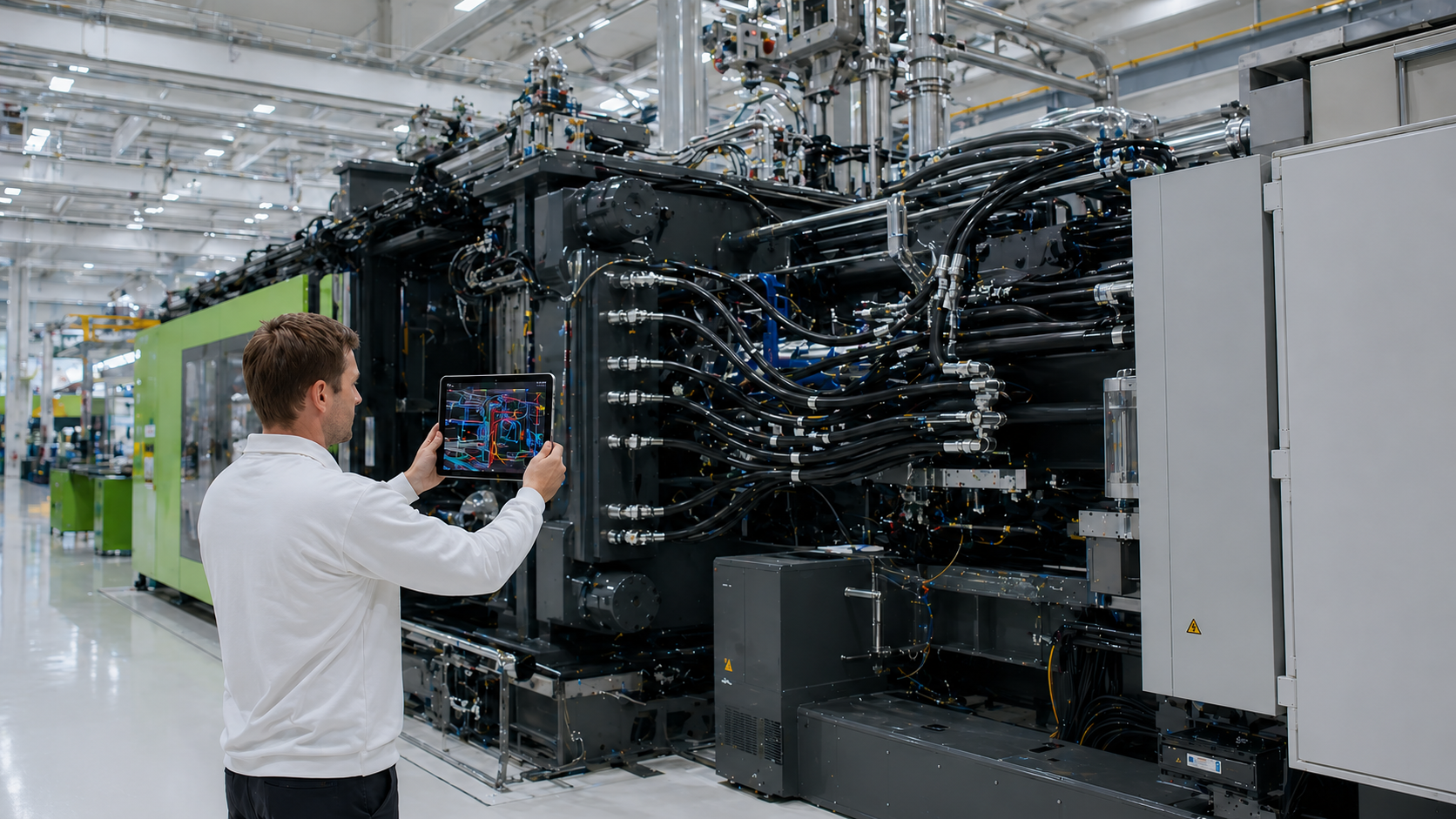
A realistic, high-quality photograph inside a clean, high-tech industrial equipment manufacturing plant. A male quality inspector in a professional uniform is holding an industrial tablet up to a massive, complex injection molding machine. On the tablet screen, an Augmented Reality (AR) overlay shows glowing digital blue and red lines indicating the exact correct routing paths for a complex bundle of hydraulic hoses, superimposed directly over the physical hoses on the machine. No VR headsets, no AR glasses. Tablet device only.
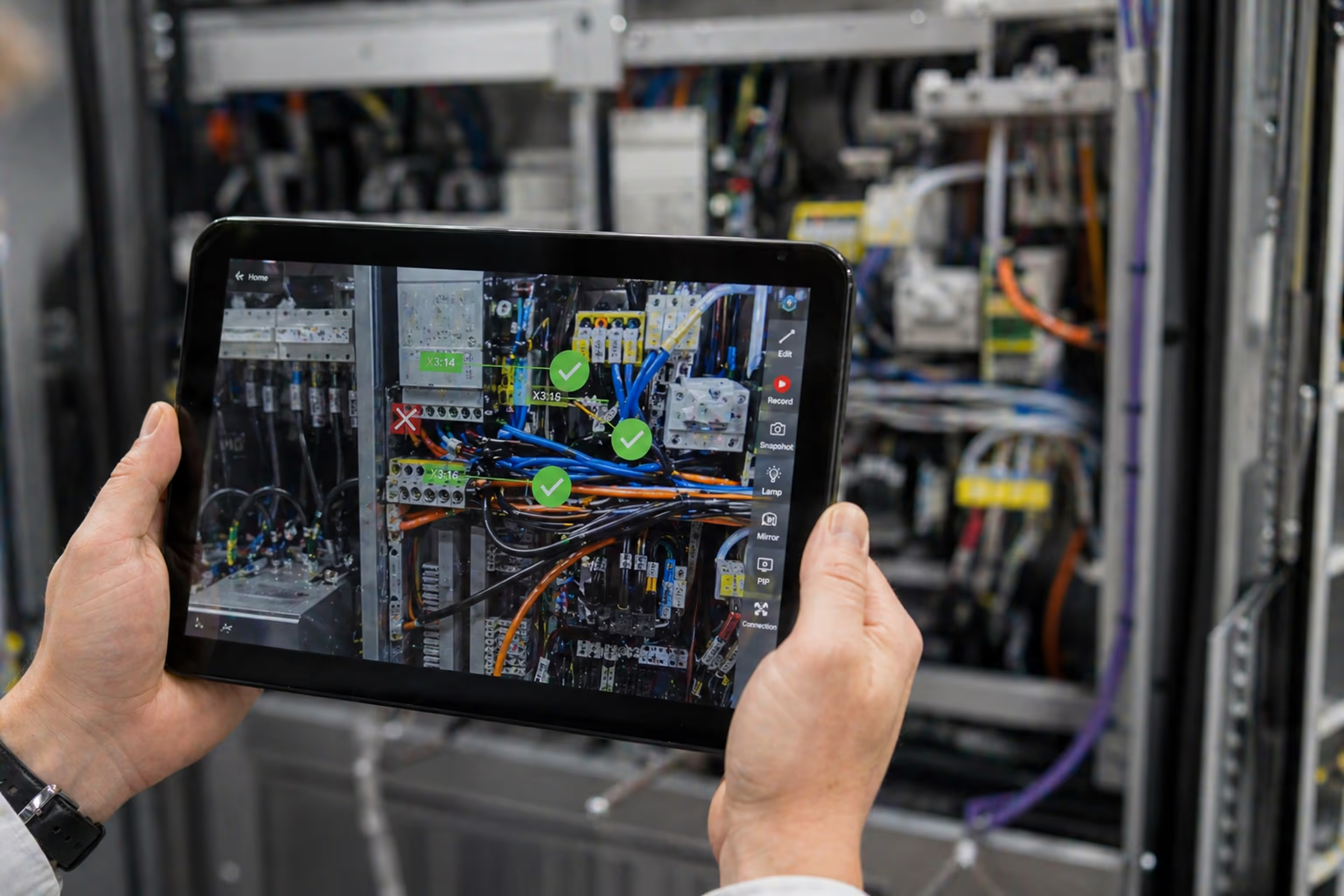
A realistic, high-quality close-up of an industrial tablet screen held by a quality inspector. The screen shows a live camera view of a complex electrical wiring panel inside an industrial machine. Overlaid on the live view is a digital green checkmark next to a correctly wired terminal, and a digital red “X” next to a wire that is plugged into the wrong port, instantly highlighting the assembly error. No VR headsets, no AR glasses.
.avif)
A realistic, high-quality photograph of a massive industrial machine wrapped in shipping plastic, ready to be loaded onto a truck. A quality inspector stands next to it, holding a tablet displaying a green “Final AR Inspection Complete - Approved for Shipping” dashboard. The mood conveys confidence, quality assurance, and readiness for delivery. No VR headsets, no AR glasses.
Frequently Asked Questions
Q1Can a similar AR solution work for my industry/problem?
A: Absolutely. While this case study focuses on injection molding machinery, the core principles of tablet-based AR for quality assurance are applicable across any industry that deals with complex assembly and stringent quality control. Whether you are in aerospace, automotive, or heavy machinery manufacturing, if your process involves verifying intricate wiring, hydraulic systems, or mechanical assemblies against custom schematics, a similar AR solution can be adapted to your specific needs. It excels in environments where precision and error prevention are paramount.
Q2How long does it take to deploy and what does it cost?
A: The deployment timeline and cost can vary depending on the complexity of your machinery and the scale of the implementation. A typical pilot program can be deployed in a matter of weeks to demonstrate value on a specific production line. This allows for a phased rollout that minimizes disruption and manages costs effectively. For a detailed quote and a customized deployment plan tailored to your specific operational needs, we recommend a consultation with our solution experts.
Q3What's the ROI and how soon will I see results?
A: The Return on Investment (ROI) is multi-faceted. As seen with Engel Austria, you can expect a significant reduction in inspection times and a sharp decrease in costly errors that are typically discovered during customer commissioning. This translates to direct cost savings from reduced field service interventions and increased throughput. The intangible benefits, such as improved customer satisfaction and a stronger brand reputation for quality, are equally valuable. Most clients begin to see a measurable impact within the first few months of a pilot program.
Q4How do I get started? What's the next step?
A: Getting started is straightforward. The first step is to schedule a discovery call with our team to discuss your specific challenges and objectives. We can then arrange a demonstration of the solution and work with you to define a pilot project. To begin the conversation, please contact Rrahul Sethi at rrahul@metaverse911.in for inquiries in India, or Vandana Bansal at vandana@metaverse911.co.uk for all global inquiries.
For India: Rrahul Sethi at rrahul@metaverse911.in
For Global inquiries: Vandana Bansal at vandana@metaverse911.co.uk