
The Story
In the high-stakes world of heavy-duty truck manufacturing, precision isn’t just a goal; it’s the bedrock of a global reputation. At the core of every heavy-duty truck lies an engine a symphony of complex engineering. Yet, this very complexity had become a monumental operational challenge. The Gothenburg facility was tasked with managing a staggering 13,000 engine variants. For the quality assurance (QA) teams on the ground, this diversity was less a marvel of engineering and more a formidable, relentless operational hurdle. The pressure tomaintain the manufacturer's legendary quality standards in the face of such overwhelming variety, was immense.
For generations, the QA process had been a fragile dance of human memory and painstaking diligence, a system straining at the seams. Imagine a new operator, fresh from the classroom, clipboard in hand, standing before a newly assembled engine. They faced a daunting five-week training program, a trial by fire designed to instill the 40 specific quality checks for just the 200 most common engine variants. This left a massive gap in coverage, relying on the tribal knowledge of a few seasoned veterans to handle the thousands of less common, but equally critical, configurations. The human cost of this system was palpable and pervasive. Seasoned inspectors felt the constant, nagging anxiety of a potential miss—a single forgotten check among thousands that could lead to a costly recall, brand damage, and, worst of all, a compromise in safety. New hires felt the immense pressure to perform, knowing that their inexperience was a direct risk to the production line's integrity. This steep learning curve wasn't merely a training issue; it was a significant bottleneck, a drag on the entire workforce's agility and morale.
The moment of reckoning arrived not with a single catastrophic event, but with the slow, grinding realization that the old way was unsustainable. The trigger was a perfect storm of market demands: increasing customization options for customers, shorter product cycles, and a tightening labor market. Every time a production line shifted to a new engine model, the QA team braced for impact. The process of updating, printing, and distributing the thick binders of paper-based quality checklists would consume over a full day. In that 24-hour window, the plant was effectively flying blind, exposed to potential quality escapes that could tarnish a brand synonymous with safety and reliability. A senior quality manager recounted a near-miss where a new engine variant with a relocated sensor was almost shipped without the updated check, a mistake that would have triggered a fleet-wide service action.For a company like this manufacturer, whose very identity is built on trust this was an unacceptable risk. The leadership knew they had to act.
The challenge was clear and urgent: the manufacturer needed a solution that could empower its operatorsnot overwhelm them. They had to streamline the QA process, eliminate the reliance on memory, and weave a digital safety net to ensure their commitment to quality was embedded in every single engine that rolled off the assembly line. The answer was not to compromise on the engineering brilliance of the engines, but to radically simplify the process of inspecting them. The company needed a technology that could tame the beast of variability, slash the cognitive load on its workforce, and provide a digital, dynamic, and error-proof method for quality assurance. This urgent need for a smarter, more agile approach to quality control set the stage for a technological revolution on the factory floor, one that would be driven not by futuristic headsets, but by the practical power of a simple tablet.

How It Works
The manufacturer's solution was to embrace the power of Augmented Reality, but with a practical, shop-floor-first approach. Instead of cumbersome headsets or glasses, the company deployed a sophisticated yet intuitive tablet-based AR solution. This system, powered by advanced computer vision tracking, fundamentally transformed the quality assurance workflow. The reliance on human memory and cumbersome paper binders was replaced by the precision, consistency, and efficiency of digital technology.
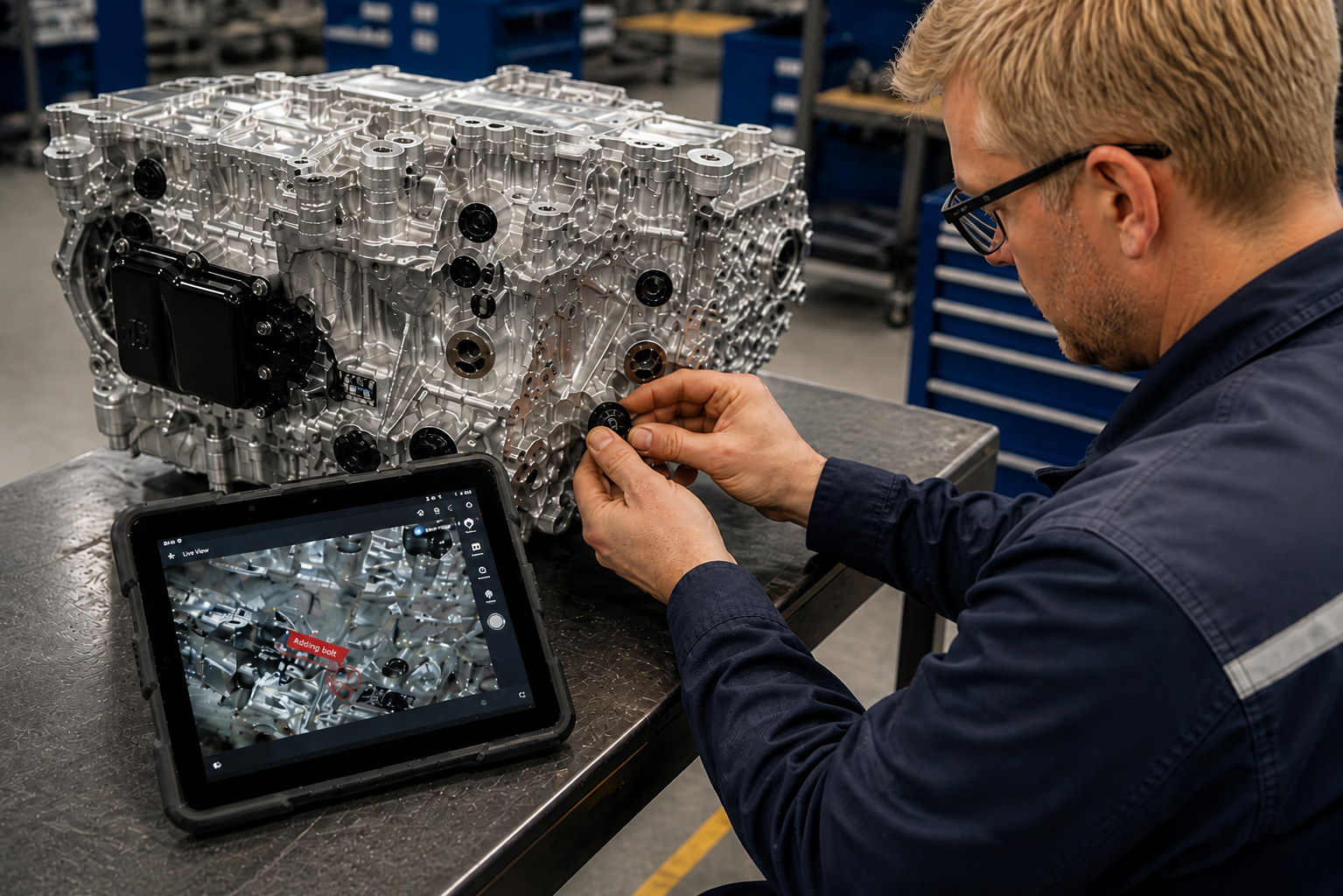
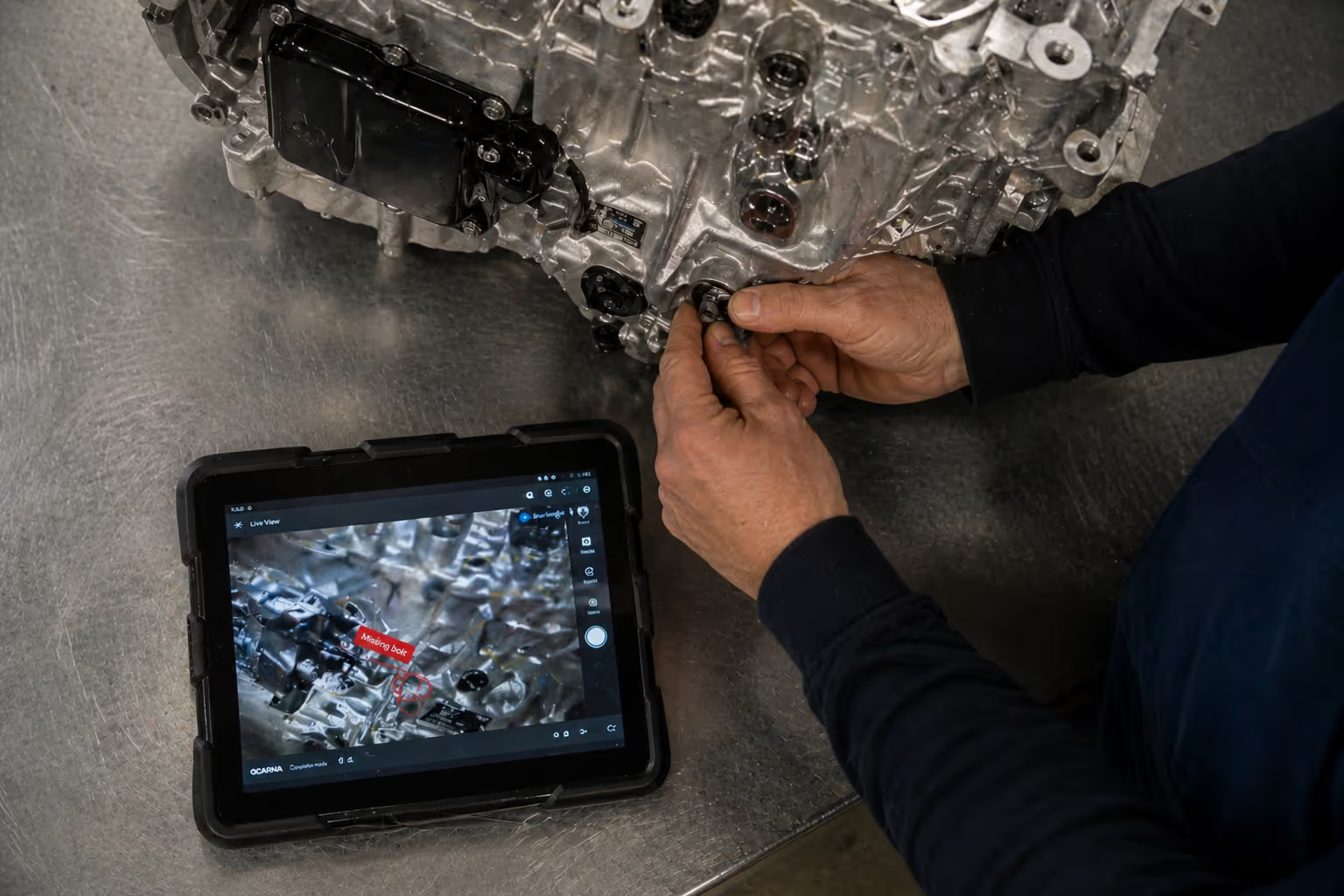
Operators on the production line are now equipped with ruggedized industrial Android and iPad tablets. When an operator points the tablet's camera at a newly assembled engine, the system instantly recognizes the specific engine variant from thousands of possibilities. This is where the magic happens: the tablet screen comes alive, overlaying the corresponding 3D CAD data and a dynamic, step-by-step list of quality checkpoints directly onto the live view of the physical engine. The AR application guides the operator through the 40 specific checks required for that exact engine configuration, a process that now takes a mere 8 minutes. The system provides unambiguous visual guidance, effectively eliminating guesswork and the potential for human error.
This is not just a digital checklist; it's an interactive, context-aware guidance system. It ensures that every operator, regardless of their experience level, can perform a complex, variant-specific inspection with the accuracy of a seasoned expert. The tablet becomes a window into the digital twin of the engine, a tool that empowers the workforce with the right information, at the right time, right at the point of work. The data flow is seamless. As the operator completes each check, they confirm completion on the tablet, and the results are automatically logged and fed back into the plant’s Manufacturing Execution System (MES). This creates a real-time, auditable digital record of every inspection, providing unprecedented traceability. If an issue is found, the operator can capture a photo, annotate it directly on the tablet, and instantly route it to the engineering or maintenance teams for resolution.
Change management was a key focus. The rollout included hands-on workshops where operators could see the benefits firsthand, quickly realizing the tablet wasn’t a replacement for their expertise, but a powerful tool to augment it. The intuitive nature of the app meant that training on the tool itself was minimal, allowing the focus to remain on quality standards.

Departmental Impact
The implementation of this tablet-based AR solution sent ripples of positive changeacross multiple departments within the truck manufacturer, fundamentally reshaping workflows and inter-departmental collaboration.
For the Quality Assurance Department, the impact was immediate and profound. The system elevated the role of the quality inspector from a memory-based checker to a technology-empowered auditor. With the tablet visually confirming the correct configuration against the digital master model, inspectors could perform complex, variant-specific checks with near-perfect accuracy. This data-driven approach to quality control not only reduced the risk of defects but also provided a new level of confidence and traceability in the inspection process.
The Training & HR Department experienced a paradigm shift in how they onboarded new talent. The cognitive load on new hires was drastically reduced. Instead of spending weeks memorizing complex procedures, new operators could become productive members of the QA team in a fraction of the historical time. This acceleration of workforce readiness meant that the company could respond more dynamically to changes in production demand and personnel, a critical advantage in a competitive global market.
The IT Department, which was instrumental in the deployment, saw this as a landmark project in digital transformation. They managed the integration points between the AR platform and the core MES, ensuring a secure and reliable flow of data. Their work enabled the creation of a robust digital thread, connecting the physical factory floor to the central data repository. This success provided a scalable blueprint for future Industry 4.0 initiatives across the organization.
The Production Department benefited from smoother, more predictable workflows. The reduction in QA-related bottlenecks and the faster resolution of quality issues meant less downtime and higher overall equipment effectiveness (OEE). Supervisors on the line had real-time visibility into the status of quality checks, allowing them to better manage the flow of production and anticipate potential problems before they escalated.
Finally, the Manufacturing Engineering department was freed from the cumbersome and time-consuming process of managing paper-based documentation. Engineers could now push updates to the QA checklists digitally across the entire plant in under an hour. This agility ensured that the production line was always in sync with the latest engineering changes, guaranteeing immediate compliance and eliminating the window of vulnerability that existed during the transition period with the old paper-based system.
Quantified Business Impact
The true measure of any technological innovation in a manufacturing environment is its quantifiable impact on the bottom line. In this regard,the truck manufacturer's tablet AR solution delivered exceptional, measurable results that built a compelling business case for its widespread adoption.
The most dramatic improvement was in workforce training. The company achieved a 60% reduction in training time, cutting the onboarding period for new QA operators from a full five weeks down to just two. This acceleration in time-to-competency translated directly into significant cost savings and increased operational flexibility. Beyond the hard numbers, this led to a marked improvement in employee retention within the first year of employment, as new hires felt more confident and successful in their roles far sooner.
The agility of the quality assurance process itself was transformed. The time required to update QA checklists across the facility was reduced from over a day to less than one hour. This near-instantaneous update capability was critical for a high-mix manufacturing environment, ensuring that quality control kept pace with engineering and production changes. This newfound speed directly impacted time-to-market for new engine variants, allowing the manufacturer to respond to customer demands more swiftly.
These operational improvements culminated in substantial financial gains. The manufacturer reported saving thousands of Euros per station annually. When scaled across the initial deployment of 5 quality stations per plant in 20 global plants, the savings become a significant figure, demonstrating a clear and rapid return on investment, with most plants achieving full ROI within 14 months. Furthermore, the rich, structured data captured by the tablets provided invaluable insights for the engineering teams, leading to a 15% reduction in design-related quality issues in the subsequent engine generation. The improved quality and faster delivery times also correlated with a measurable uptick in customer satisfaction scores for the truck models using these engines.
Conclusion
The heavy-duty truck manufacturer case study is more than just a successful technology implementation; it is a blueprint for the future of manufacturing. It demonstrates that Augmented Reality, when applied pragmatically and thoughtfully, can solve some of the most pressing challenges in the industry: managing complexity, empowering the workforce, and driving operational excellence. By choosing a tablet-based approach, the manufacturer prioritized usability and scalabilityensuring that the solution could be seamlessly integrated into the existing factory environment without the need for specialized headgear or extensive infrastructure changes.
The results speak for themselves. A 60% reduction in training time, a 90% reduction in the time it takes to update quality checklists, and significant cost savings are not incremental improvements; they are transformative. This case study proves that the true power of the industrial metaverse lies not in futuristic visions, but in practical applications that deliver measurable value today. For other manufacturers facing similar pressures, tthe lesson from the manufacturer is clear the time for paper checklists is over. The time to augment your workforce with practical, powerful tools is now. Imagine your own operations running with this level of precision, agility, and data-driven insight. That future is not a distant dream; it is an achievable reality.
Frequently Asked Questions
Q1Can a similar AR solution work for our operations in the aerospace/medical device/heavy machinery industry where complex assembly and stringent quality control are critical?
Absolutely. The principles demonstrated in the Volvo Trucks case study are directly applicable to any industry that deals with high-mix, complex products and requires rigorous quality assurance. Tablet-based AR is a proven tool for reducing human error, improving training effectiveness, and ensuring process compliance, whether you are assembling jet engines, manufacturing medical implants, or building construction equipment. The key is the ability to overlay digital instructions and 3D models onto physical objects, which is a universal need in precision manufacturing.
Q2 How long does it take to deploy a tablet-based AR solution for a specific use case, and what are the main cost components?
A pilot project for a single, well-defined use case, like quality inspection at one station, can typically be deployed in 8-12 weeks. The primary cost drivers include software platform licensing, the one-time effort to create or convert your existing 3D CAD models into AR-ready assets, and integration with your backend systems like MES or PLM. The hardware cost is often minimal as the solution runs on standard industrial tablets.
Q3What is the typical ROI for a project like this, and how soon can we expect to see results beyond just training time reduction?
Most companies see a full return on investment in under 12-18 months. While the 60% reduction in training time seen at Volvo is a major driver, you will also see significant ROI from other areas. These include a measurable reduction in manufacturing defects and rework (often a 20-30% improvement), increased operator productivity, and the elimination of costs associated with printing and distributing paper-based work instructions. The biggest, often unmeasured, benefit is the improvement in overall product quality and brand reputation.
Q4We are interested in exploring this further. What is the best way to get started?
The best next step is to schedule a 30-minute discovery call to assess your specific use case. We can then arrange a live demo tailored to your operational challenges. To get started, please contact Rrahul Sethi at rrahul@metaverse911.in for inquiries in India, or Vandana Bansal at vandana@metaverse911.co.uk for all other global inquiries.
For India: Rrahul Sethi at rrahul@metaverse911.in
For Global inquiries: Vandana Bansal at vandana@metaverse911.co.uk