
The Story
In the high-stakes world of heavy machinery manufacturing, where precision is measured in millimeters and mistakes are measured in millions, One of the world's leading crane manufacturers stands as a titan. From its global headquarters in Germanythis division of a global heavy-machinery group orchestrates the design and production of some of the world’s most powerful and complex tower and mobile construction cranes. These are not just machines; they are vertical cities of steel, engineered to conquer skylines. Yet, within this temple of engineering, a persistent and costly challenge festered in the heart of the production line: discovering critical structural defects after a component had been sealed under its final, multi-layer paint job.
Imagine a colossal crane boom section, a structure of immense scale and complexity, forged from high-strength steel and perfected by the hands of master welders. It has just emerged from the paint shop,gleaming in its iconic signature yellow But then, a final quality check reveals a nightmare: a critical mounting bracket is misaligned by a few millimeters, or a load-bearing weld is incomplete. The gleaming paint, a symbol of quality and durability, now becomes a costly prison. The component, worth tens of thousands of euros, is now a production catastrophe. It must be painstakingly pulled from the tightly scheduled assembly line, disrupting the entire flow. The expensive, hardened paint—a multi-stage protective coating designed to withstand the harshest environments for decades—has to be chemically or mechanically stripped away. The underlying steel must be re-worked, re-welded, and re-finished. Finally, the entire multi-day, resource-intensive painting process must be repeated from scratch. This bottleneck wasn’t a rare occurrence; it was a chronic drain, costing the company millions of euros annually in wasted materials, lost production hours, and crippling delays.
The trigger for change wasn’t a single event, but a growing, data-driven realization that this "old way" of discovering errors at the end of the line was fundamentally unsustainable in a competitive global market. The executive team, poring over production analytics, saw the red line of rework costs cutting deep into their profit margins. The question echoed from the boardroom to the factory floor: how can we guarantee structural perfection before the point of no return? How can we make the paint shop a final seal of quality, not a potential graveyard for flawed components? The answer, when it came, wasn’t a billion-euro robotic overhaul or a complex, unproven new technology. It was the elegant, almost deceptively simple power of Augmented Reality, delivered not through futuristic headsets, but through the familiar and robust form factor of an industrial tablet.

How It Works
The genius of the manufacturer's solution lies not in its complexity but in its profound simplicity and seamless integration into the existing fabrication workflow. The legacy process was a relic of a bygone era: inspectors, armed with cumbersome tape measures, heavy steel jigs, and stacks of 2D paper blueprints, would manually verify the geometry of the welded components. This method was not only glacially slow but also fraught with potential for human error. A misread measurement, a slightly warped jig, or a misinterpretation of a complex drawing could lead to a flawed component being passed down the line, its hidden defects waiting to be discovered at the most expensive stage possible.
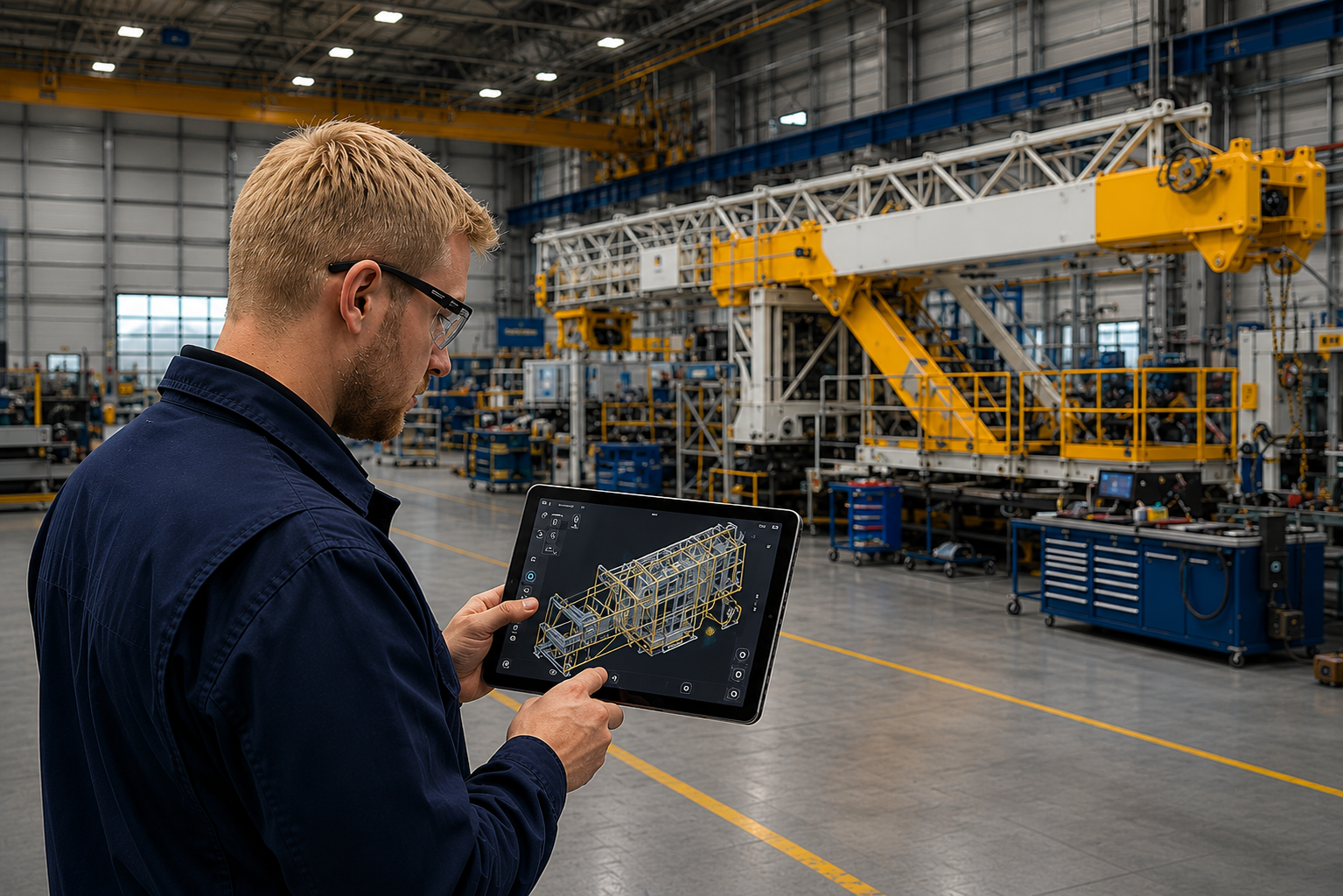
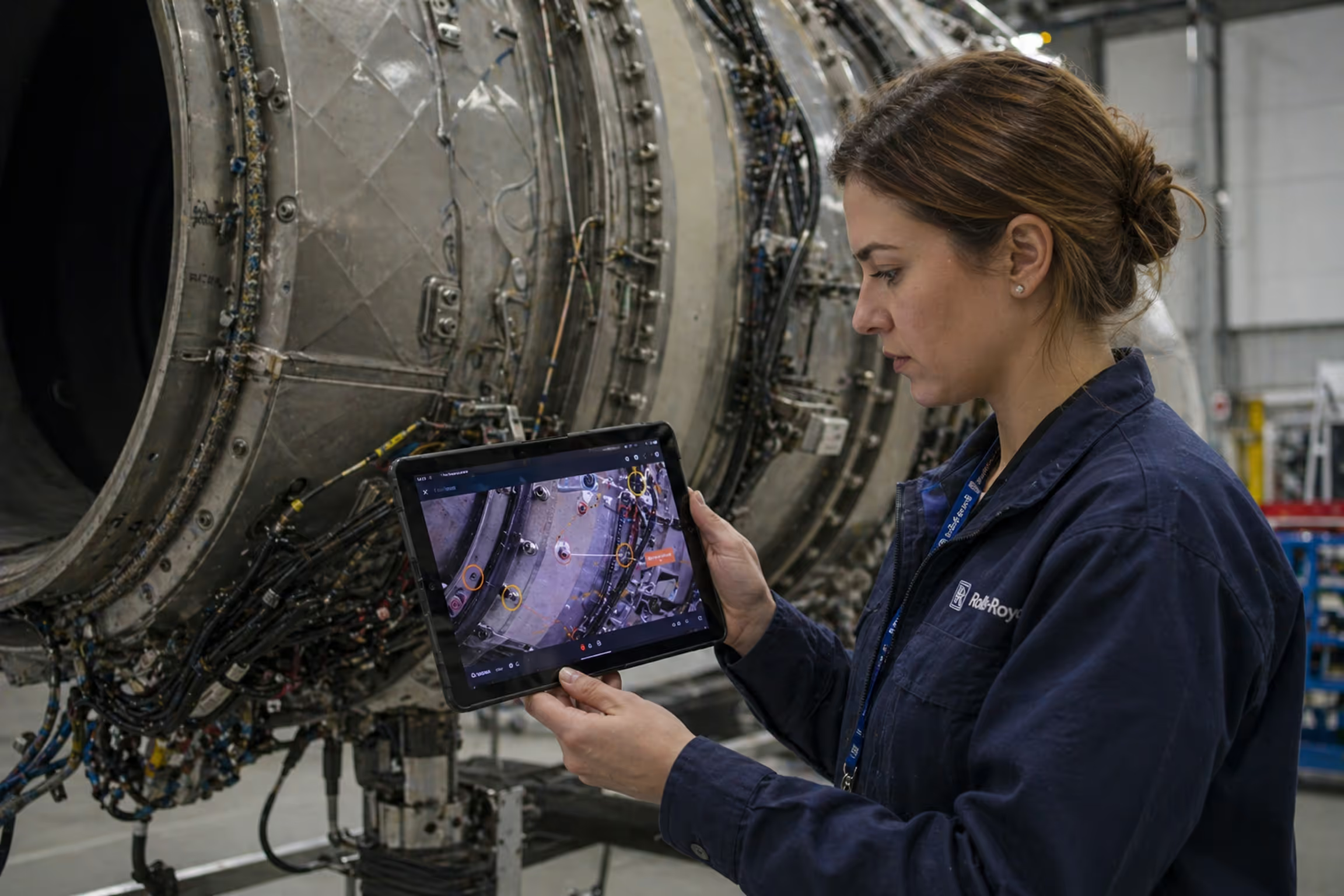
The new Augmented Reality process, however, represents a quantum leap in industrial quality assurance. It is strategically inserted into the production sequence after all welding and structural fabrication is complete, but critically, before the component enters the paint shop. A quality assurance inspector, equipped with a ruggedized, drop-proof, and water-resistant tablet—often an iPad or a specialized Android device—approaches the massive steel structure. They launch a specialized AR application, developed in partnership with a firm like Metaverse 911, which is directly linked to the manufacturer's central Product Lifecycle Management (PLM) system.
Pointing the tablet’s high-resolution camera at the crane component, the magic begins. The software’s sophisticated computer vision algorithms instantly recognize the specific geometry of the part, whether it's a boom section, a turret, or a chassis. In milliseconds, the application fetches the corresponding, master 3D CAD model from the PLM database. This isn't just a generic model; it's the absolute source of truth, the digital twin of what the physical object is supposed to be. The software then overlays this detailed, color-coded wireframe model precisely onto the live video feed on the tablet's screen.
This augmented view is transformative. The inspector is no longer just looking at a piece of steel; they are looking at the physical object and its digital blueprint simultaneously. The tedious, error-prone task of manual measurement is replaced by rapid, intuitive visual verification. The inspector can physically walk around the multi-ton component, and from any angle, the digital overlay remains perfectly anchored to the physical part. A correctly placed bracket, a perfectly angled weld, or a properly drilled hole is highlighted in a reassuring green. Conversely, any deviation—a part that is misaligned, missing, or incorrectly sized—is immediately flagged in a stark, unmissable red. The inspector can tap on any flagged area on the screen to bring up detailed specifications, required tolerances, and specific work instructions from the CAD model. This allows them to instantly understand the nature and severity of the defect. Deviations are not just noted; they are documented with military precision. The inspector can capture time-stamped, high-resolution photos and videos directly within the app, with the AR overlay clearly showing the discrepancy. These visual records are automatically appended to a digital inspection report and fed back into the Manufacturing Execution System (MES), creating a closed-loop, data-rich quality process that was previously unimaginable with the old paper-based system.
Departmental Impact
The implementation of the tablet-AR inspection process was not a siloed project; it was a catalyst for cultural and operational change, creating positive shockwaves thatresonated across the entire manufacturing facility It broke down long-standing information silos and created a unified, common visual language for quality that every stakeholder, from the welder on the floor to the engineer in the design office, could understand. The QA department, for instance, transformed from being reactive record-keepers of defects to proactive guardians of quality. Inspections that previously took hours of painstaking manual measurement were now completed in minutes with far greater accuracy and confidence. The system provided an objective, data-driven feedback loop directly to the fabrication teams. A welder could now see a visual, unambiguous record of a deviation, understand the required correction, and learn from it. This fostered a culture of continuous improvement, not based on criticism, but on clear, actionable data. Furthermore, the digital, time-stamped inspection reports created a permanent, unimpeachable, and auditable trail of quality for every single component, strengthening compliance and traceability.
The production line experienced the most dramatic and immediate financial benefits. The chronic, soul-destroying problem of late-stage defect discovery was virtually eradicated. The paint shop, once a potential source of major bottlenecks, now received a steady flow of 100% correct structures. The costly and disruptive rework loop—stripping, re-welding, re-painting—vanished. This had a profound impact on production flow, making it smoother, more predictable, and significantly faster. The entire factory floor became more efficient as the ripple effects of these eliminated delays spread through the assembly process, increasing overall throughput and enabling more accurate delivery forecasting. This newfound predictability was a significant competitive advantage in a market where on-time delivery is critical.
The AR inspection data also created a powerful and previously unavailable feedback loop to the upstream engineering and design departments. The system aggregated data on recurring deviations, providing invaluable insights into the real-world manufacturability of their designs. For instance, if a specific type of bracket was consistently flagged for minor misalignment across multiple components, it often pointed to a design element that was inherently difficult to fabricate with precision. This data allowed engineers to optimize designs for manufacturing (DfM), making subtle changes to the CAD models that would make them easier to build right the first time. The digital twin was no longer a static blueprint; it was a living document, continuously refined by real-world production data, leading to more robust and cost-effective designs in the long run.
The intuitive, visual nature of the AR interface dramatically reduced the learning curve for new inspectors. Onboarding, which used to take weeks of shadowing senior inspectors and learning to interpret complex 2D drawings, was accelerated significantly. A new hire could become a productive member of the team in a fraction of the time, guided by the unambiguous green and red signals of the AR overlay. This also had a positive effect on the veteran fabricators, providing objective, non-confrontational feedback that helped them hone their craft. This investment in accessible technology fostered a culture of continuous improvement and boosted morale, demonstrating the company's commitment to empowering its workforce with the best possible tools. The IT department was a crucial partner in the project's success, responsible for ensuring the seamless, secure, and high-speed flow of data between the PLM system, the MES, and the tablets on the factory floor. They managed the network infrastructure and the backend systems that made the real-time overlay possible. In return, the AR system provided a rich new stream of structured, high-quality operational data. This data became a goldmine for the company's growing data analytics initiatives, enabling the development of predictive quality models. The IT team could now help answer questions like, "Which welder, working on which type of component, on which shift, is most likely to produce a deviation?" This predictive capability allowed for proactive interventions before defects even occurred, taking the principle of "Shift-Left" to a whole new level.
Quantified Business Impact
The adoption of pre-paint AR inspections at the facility was a strategic business decision that delivered substantial, measurable, and rapid returns. The most significant financial win was a massive reduction in rework costs, with the company documenting a near-total elimination of post-paint structural rework. Conservative estimates placed the annual savings at several million euros, leading to a complete return on investment (ROI) in under six months, making it one of the most successful technology initiatives in the division's recent history.
Beyond direct cost savings, the AR process enforced a new level of precision that enhanced structural quality and product safety. By ensuring every component adhered strictly to its master CAD design, the manufacturer reinforced its brand promise of uncompromising German engineering and safety, significantly reducing long-term liability risks. Operationally, removing the rework bottleneck made the entire production workflow more streamlined and predictable, leading to a documented 15% reduction in the overall production cycle time for key components. This increased factory throughput and improved the accuracy of delivery forecasting to global customers.
The positive impact on the workforce also yielded measurable results. The quality and fabrication departments saw a notable decrease in employee turnover, as the investment in technology was perceived as an investment in people, fostering a more engaged and stable workforce. Finally, the new process greatly enhanced audit compliance and traceability. The AR system automatically generated a complete digital dossier for every inspection, streamlining both internal and external audits and reducing the associated time and resources by an estimated 30%

Conclusion
The manufacturer's story is a powerful testament to the “Shift-Left” quality principle. By leveraging tablet-based AR, they moved critical inspection to the earliest possible stage, preventing the exponential costs of downstream error discovery. They transformed a major production bottleneck into a streamlined, digitally-verified workflow, proving that preventing a problem is the most effective way to solve it.
The case is a critical lesson for any industry in complex fabrication. It shows that unlocking the value of the industrial metaverse doesn’t require futuristic hardware. A practical, profitable solution can be as straightforward as an industrial tablet and the right software. By bridging the gap between digital design and the physical product,the manufacturer has not only eliminated millions in rework costs but has also elevated the quality, safety, and efficiency of its entire operation.
Frequently Asked Questions
Q1We are in the [automotive/aerospace/shipbuilding] industry. Can a similar tablet AR solution work for our complex quality inspection needs?
Absolutely. The principles demonstrated at Liebherr are not specific to crane manufacturing but apply to any industry involving complex fabrication and assembly. Whether you are verifying weld points on a chassis, inspecting the lay-up of composite materials in an aircraft fuselage, or checking the structural integrity of a ship's hull, tablet-based AR provides a powerful way to overlay your master CAD designs onto the physical product. This allows for rapid, accurate, and intuitive visual verification, effectively preventing costly rework regardless of your specific industry.
Q2 How long does it take to deploy a tablet-based AR solution and what does a typical proof-of-concept cost?
Deployment time and cost can vary depending on the complexity of your products and the scale of your operation. However, one of the key advantages of a tablet-based AR solution is its accessibility and speed of implementation compared to systems requiring specialized headsets. Since it leverages existing, ruggedized industrial tablets, the primary effort involves software integration with your CAD systems and workflow customization. A pilot program can often be launched in a matter of weeks. For a detailed cost-benefit analysis and a specific quote tailored to your needs, we recommend a personalized assessment.
Q3What is the typical ROI on a pre-paint AR inspection system and how soon can we expect to see results?
The Return on Investment (ROI) is significant and often realized very quickly. The primary driver of ROI is the near-total elimination of rework costs associated with post-paint defect discovery, which, as seen in the Liebherr case, can run into millions. You can expect to see a direct impact on your bottom line almost immediately after implementation by preventing these costly errors. Secondary returns include increased production throughput, improved delivery predictability, and enhanced overall product quality and safety, which contribute to long-term profitability and brand reputation.
Q4We are convinced this is the right approach for us. How do we get started and what are the next steps?
The next step is to schedule a personalized assessment with one of our lead consultants. They will work with you to understand your specific challenges, analyze your current quality control process, and outline a clear implementation roadmap. To begin this process, please contact our regional lead: for inquiries in India, please email Rrahul Sethi at rrahul@metaverse911.in. For all other global inquiries, please email Vandana Bansal at vandana@metaverse911.co.uk.
For India: Rrahul Sethi at rrahul@metaverse911.in
For Global inquiries: Vandana Bansal at vandana@metaverse911.co.uk